
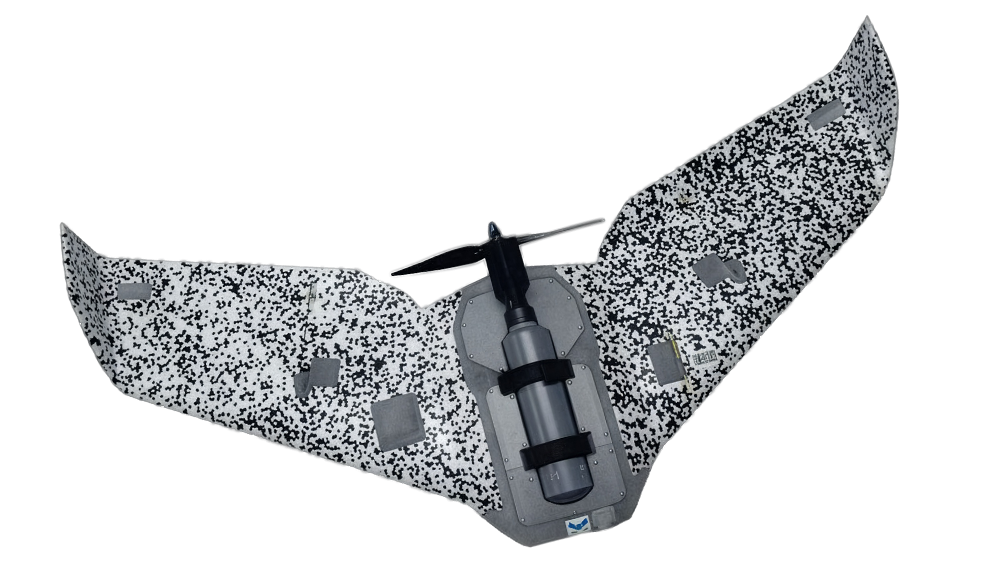

BladeStrike
Product descripton: BladeStrike by Adler Aerospace
BladeStrike™ is a one-way UAV platform derived from the proven BladeRanger airframe. It retains the common fuselage, avionics, system architecture, deployment equipment, and ground-control ecosystem of the BladeRanger family.
The platform replaces the original ISR payload configuration with a streamlined forward-facing electro-optical camera and a modified internal payload arrangement. This preserves the common airframe architecture while adapting the system for a dedicated one-way mission profile.
System Architecture
- Common BladeRanger-derived airframe and avionics architecture
- Modular payload integration
- Shared ground-control and communications ecosystem
- Common deployment equipment
- Compatible mission-planning software environment
- Remotely piloted or autonomous operation
- Designed for operation in demanding field environments
Mission & Interoperability
BladeStrike is designed to operate within a broader UAV ecosystem alongside BladeRanger.
BladeRanger
- Long-range ISR
- Surveillance and reconnaissance
- Target identification
- Post-mission assessment
BladeStrike
- Dedicated one-way mission platform
- Forward electro-optical sensing
- Autonomous and remotely supervised operation
- Shared command, communications, and logistics infrastructure
This common architecture is intended to reduce training, deployment, and logistics requirements when the two platforms are operated as part of the same UAV family.
Deployment & Portability
- Pneumatically assisted launch system
- Common deployment equipment with BladeRanger
- Two-person field deployment concept
- Rapid field setup
- IP67-rated transport case
- Weatherized system architecture
- Compact ground-control footprint
- Transport system designed for harsh field conditions
Communications & Control
- Digital video transmission architecture
- Protected communications
- Encrypted data communications
- Proprietary signal-management technology
- Ground-control integration
- Remote antenna-control capability
- Mission-planning software based on ArduPilot Mission Planner with customized firmware
Navigation & Autonomy
The platform combines multiple navigation and autonomy technologies, including:
- GNSS-based navigation
- GNSS-resilient navigation architecture
- Inertial navigation
- Visual navigation
- Redundant navigation sensors
- Mission-planning autonomy
- Computer-vision-based scene recognition
Environmental & Survivability Characteristics
- Ruggedized field architecture
- Weatherized components
- Operation across a broad temperature range
- Wind-tolerant launch capability
- Low acoustic signature
- Low-observable visual and radar characteristics
- Redundant critical systems
Technical specifications
| Category | Specification |
| Platform | BladeRanger-derived UAV airframe |
| Configuration | One-way UAV |
| Flight Endurance | Approx. 60 minutes |
| Cruise Speed | 65 km/h |
| Maximum Speed | 115 km/h |
| Operating Altitude | 200–600 m |
| Flight Ceiling | 10,000 ft |
| Environmental Temperature | −20°C to +49°C |
| Maximum Launch Wind | 14 m/s |
| Acoustic Signature | <10 dBA at 120 m |
| Deployment Time | Approx. 5 minutes |
| Deployment Crew | 2 persons |
| Transport Case | IP67 field case |
| Case Drop Resistance | 1 m |
| Case Crush Resistance | 90 kg |
| Communications Encryption | 256-bit AES |
| Video System | Digital forward video system |
| Video Camera | RunCam WiFiLink2 / OpenIPC-based |
| Image Sensor | Sony IMX415 |
| Lens | 60° field of view |
| Sensor Size | 1/2.8″ |
| Mission Planning | ArduPilot Mission Planner |
| Ground Control | Compact HMI footprint |
| Navigation | GNSS / inertial / visual navigation |
| Navigation Sensors | Redundant gyroscopes, barometers and magnetic compasses |
| Deployment Method | Pneumatically assisted launcher |