Why MultiVector Airflow Sensor Outperforms Pitot Tubes for Multirotor UAS Navigation
Pitot tubes are a reliable staple in aviation. But the shortcomings of conventional fixed-wing airspeed sensors are rather apparent for multirotor UAS.
Because multirotors hover, fly sideways, reverse direction, and operate at low speeds inside rotor-disturbed airflow, Pitot tubes can produce weak, incomplete, or misleading readings.
The solution? Equip your platform with a multiVector airflow sensor (MAS) instead.
Why Pitot Tubes Struggle at Low Multirotor Airspeeds
Pitot tubes measure the difference between total and static pressure, from which airspeed is calculated.
Dynamic pressure increases with the square of airflow velocity. As the aircraft slows down, the available pressure signal therefore collapses rapidly. At standard sea-level density, dynamic pressure is approximately:
- 2.45 Pa at 2 m/s
- 15.3 Pa at 5 m/s
- 61.3 Pa at 10 m/s
Yet, at the bottom of this range, even a minor sensor bias can create a substantial airspeed error. At 2 m/s and standard sea-level density, a 1 Pa pressure error corresponds to an airspeed error of approximately 0.41 m/s using a small-error approximation.
And that’s a major issue for multirotor UAS because many routine operations take place below 5-10 m/s. Inspection flights, precision approaches, autonomous hovering and stop-start manoeuvres may all occur where conventional pitot readings are least dependable.
That said, pitot sensing can still provide useful airspeed information during sustained forward translation. But its performance degrades at near hover speed, plus susceptible to degradation due to probe placement or calibration.
Why Multirotors Need Full-Vector Airflow Data
A forward-facing pitot tube captures only a fraction of what a multirotor experiences in flight. Because multirotors move and encounter wind from every direction, they need a sensor that measures the full airflow vector.
The mismatch shows up in two places: omnidirectional flight and rotor-disturbed airflow.
Single-Axis Pitot Tubes Miss Omnidirectional Flight
A conventional pitot tube primarily measures the airflow component aligned with its longitudinal axis. For a fixed-wing aircraft flying forward, that makes sense. The nose generally points in the direction of travel, and airflow remains broadly aligned with the probe.
But multirotors routinely perform lateral translation, backwards flight, diagonal movement, rapid yaw rotations, and stationary hover in crosswinds. During these manoeuvres, airflow can approach the aircraft from almost any direction. So a forward-facing Pitot tube may under-read the true airflow or fail to distinguish between forward motion, crosswind, reverse flight and sideslip.
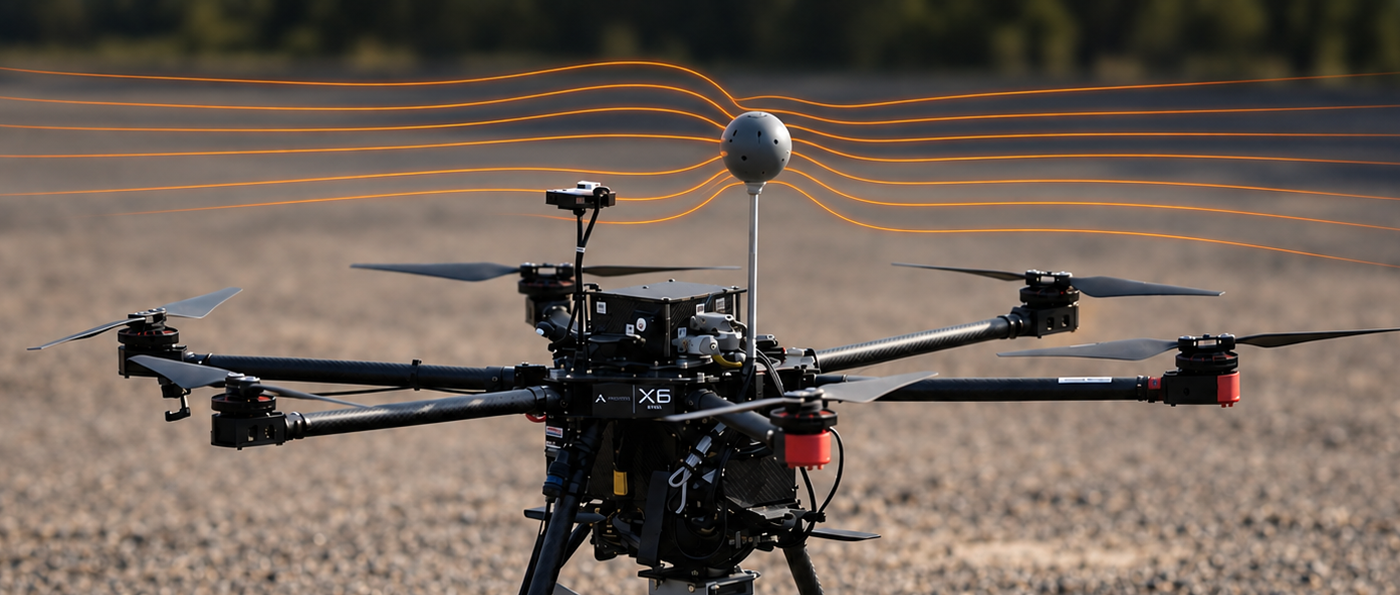
In contrast, a MAS can help you capture 360-degree information about airspeed and airflow direction by using a set of high-performance pressure sensors. Our Multivector AirFlow Sensor for UAVs, for example, delivers an airspeed accuracy of ±2% and measures the wind-vector direction within ±5 degrees. So your aircraft have magnitude and direction of the surrounding airflow data, regardless of its heading or direction of travel.
Rotor Wash Distorts Pitot Tube Measurements
Every multirotor propeller produces downwash, turbulent vortices, recirculating airflow, and pressure fluctuations. The resulting flow field changes with factors like:
- Motor speed and throttle
- Payload weight
- Flight attitude
- Battery state
- Ground proximity
- Atmospheric wind
- The direction of movement
In hover, separate rotor wakes can merge beneath the aircraft. During forward flight, the wake becomes skewed. Near the ground, non-uniform outwash and recirculation can develop around the fuselage.
A Pitot tube mounted near the frame or rotors may capture disturbed airflow rather than the true relative wind. A forward boom can reduce interference, but adds drag, vibration, structural complexity, and crash vulnerability. Even then, performance may still degrade in hover, descent, or aggressive manoeuvres.
Rather than relying on a single pressure measurement from one direction, MAS combines data from multiple sensor orientations. Its integrated processing unit converts those measurements into usable airspeed and wind-vector information, giving the navigation stack a more complete picture of the aerodynamic environment.
While some degree of rotor wash remains, multidirectional measurements provide the estimator with substantially richer input than a forward-facing pitot tube can.
The extra advantage you get with Bavona MAS is extra hardware ruggedization. Our sensor is designed to resist rain, dust, ultraviolet exposure, and mechanical vibration, addressing several of the environmental and installation risks associated with external air-data hardware.
Unmeasured Wind Turns Into Navigation Drift
For multirotor aircraft, wind is a direct source of navigation and positioning error. Every gust changes the forces acting on the vehicle. Without direct airflow measurements, the navigation stack must infer those forces from attitude, acceleration, motor response, groundspeed, and position changes.
When GNSS is available, satellite-derived velocity and position can help the estimator identify wind-induced movement. But in a GNSS-denied environment, that external reference may become unreliable or disappear completely. So unobserved wind can gradually contribute to dead-reckoning error and positional drift.
A multidirectional airflow sensor gives the navigation filter an additional physical measurement of the aircraft’s surrounding environment. With MAS, the flight-control system can detect and compensate for external aerodynamic disturbances by estimating wind speed and direction.
So you gain:
- More stable autonomous hovering
- Better wind and gust compensation
- Improved precision landing
- More accurate payload delivery
- Stronger dead-reckoning performance
- More reliable control during low-speed missions
- Greater resilience when GNSS cannot be trusted
With MAS, wind becomes a measurable navigation input, even in GNSS-denied conditions.
How Bavovna MAS Integrates With the Flight Stack
Better airflow data only creates value if the aircraft can use it.
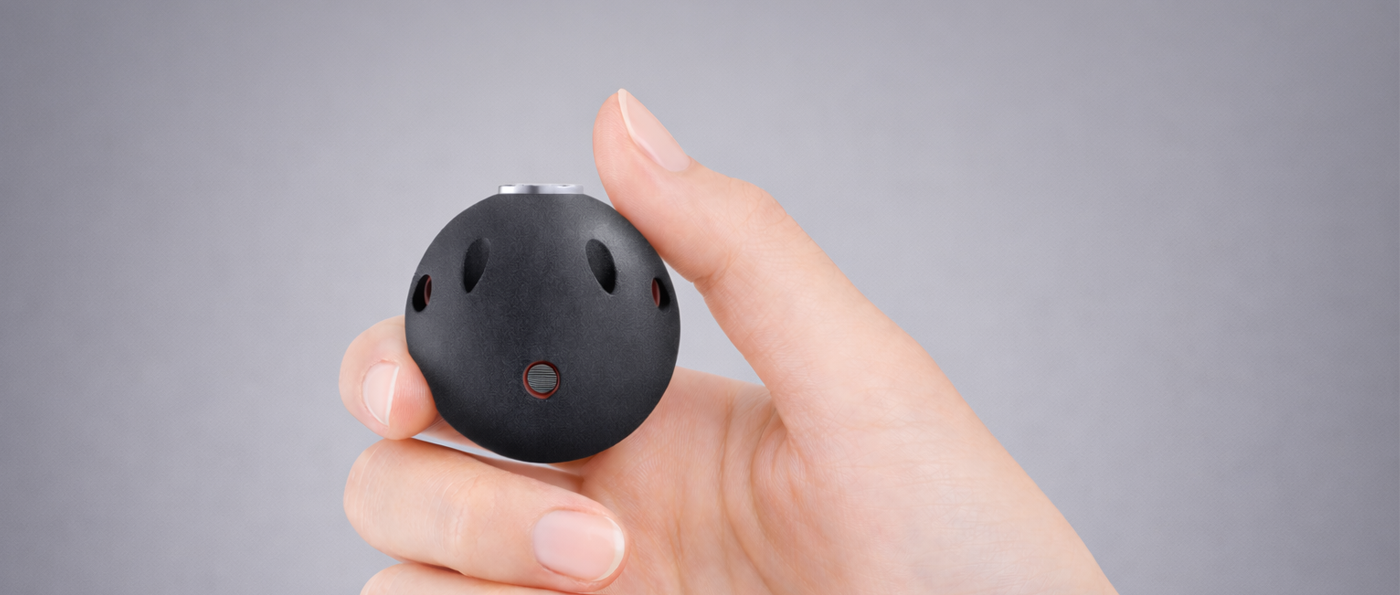
Bavovna MAS is designed as a complete airflow-sensing subsystem rather than an isolated pressure probe. It combines six or nine pressure sensors (depending on the requested configuration), environmental and humidity sensing, and onboard processing within one unit.
The processed airflow data is delivered through a serial digital interface, with support for MAVLink v2.0 and ArduPilot-based UAV architectures. This allows you to easily integrate wind-vector and airspeed data into existing navigation and control stacks.
Our MAS is also designed to limit its impact on platform resources:
- Weight: 250 g
- Diameter: 60 mm
- Optional mast: 200 mm
- Power supply: 5 V DC
- Power consumption: 1 W
Effectively, you can add full-vector airflow sensing without imposing a major electrical load on the aircraft. Actual weight suitability will naturally depend on the size and payload capacity of the target UAV.
Explore the technical specifications and integration options for the Bavovna MultiVector Airflow Sensor for UAVs.