The Technology for Protection Against Jet-Powered Reactive Strike Drones
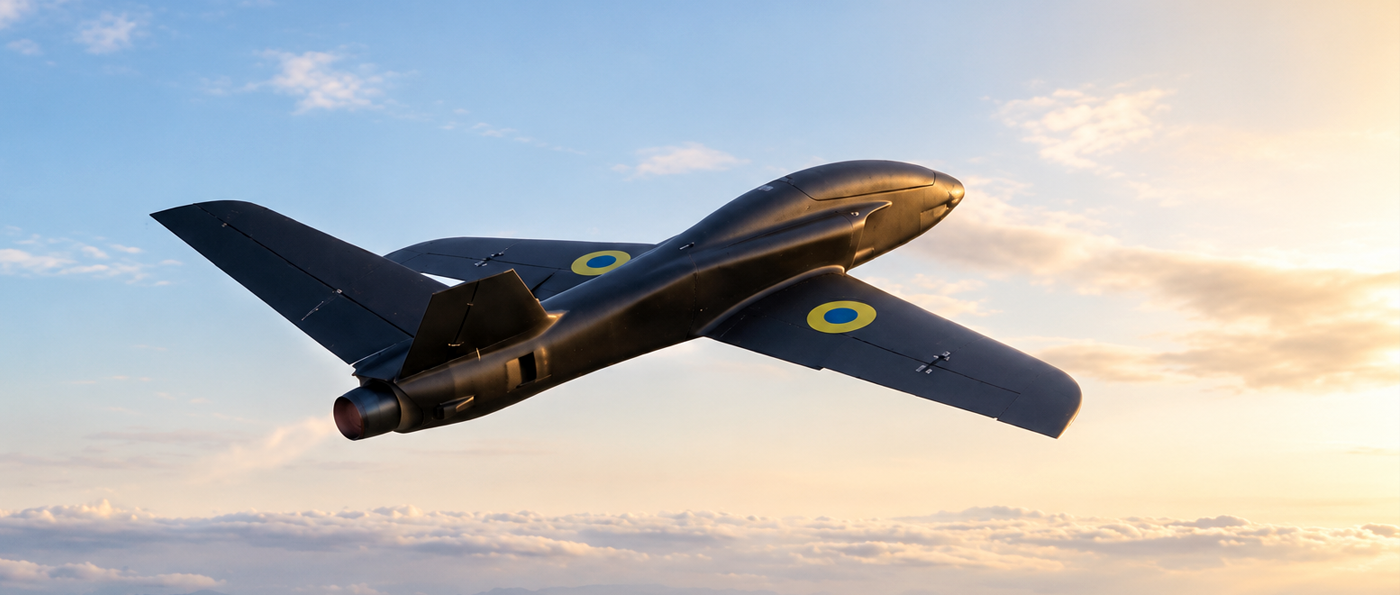
Jet-powered strike drones have become a common menace on the battlefields. According to Ukraine’s air force, Russia launched 2,800 jet-powered drones in August 2026, up from just 350 in June 2026.
With cruising speeds between 300–600 km/h and higher flight altitudes, these threats give air-defence crews far less time to detect and respond. But counter-UAS technology is rapidly catching up.
In the matter of weeks, Ukraine has managed to achieve a 60% interception rate for reactive strike drones. Although new defence measures are still a work in progress, several technologies are already proving essential to effective protection.
3 Core Technology Layers for Protection Against Reactive Strike Drones
Defenders need to act quickly enough to stop reactive strike drones. That takes several technologies working together, each with a different job:
- Sensor-driven detection and fire control to spot incoming threats and coordinate a response.
- High-speed interceptor drones to catch and take down fast-moving targets.
- Directed-energy weapons to add another layer of protection against smaller drones that remain a threat.
Let’s look at how each fits into the bigger picture.
Advanced Detection Systems
Effective protection begins with having a reliable picture of the airspace.
Jet-powered drones may be fast, but they can still be locked with 3D radars. For instance, Hensoldt’s SPEXER 2000 3D MkIII is fine-tuned for detecting small and nano UAV threats and loitering munitions. It also includes automatic target classification and supplies tracking information to several weapon types, including air-defence missiles and lasers. The system tracks targets accurately, even against the clutter of a city.
That said, other sensors should also be in place. Radio-frequency receivers can supply control or telemetry transmissions. Optical and ER cameras can provide visual confirmation or heat signatures of incoming threats. Their complementary roles matter because a smaller reactive strike drone may be difficult to distinguish from other objects using one sensor alone.
Agile Kinetic Interceptors
Interceptor drones also recently got a ‘jet’ upgrade to catch the faster threats. Wild Hornets has recently shown successful interception of a dozen Geran-4s and several Geran-5s reactive strike drones during combat trials with its new Sting S interceptor.
Sting S is still keeping some specs under wraps. What we do know: it retains the four-rotor quadcopter design, now larger and aerodynamically refined for faster cruising. The company says mass production is next, though it has yet to put a date on it.
Better controls are helping, too. The reported reactive strike drone interceptions were made with the Hornet Vision Ctrl remote-piloting system, which had increased from nine to 25 channels, allowing more crews to operate under one radar. Effectively, the company puts equal weight on improving both its software and hardware to expand defensive capacity.
Directed‑Energy Weapons (DEW)
Directed-energy weapons are another layer gaining strong ground, primarily thanks to their cost-effectiveness. Lasers can take down targets with concentrated light, while high-power microwave rays disrupt or damage their electronics. Both reduce reliance on expendable ammunition.
The US military is testing how DEW fit into existing air defences. In a live-fire exercise in June 2025, soldiers at Fort Sill tested laser prototypes against drone swarms alongside conventional weapons.
Later, in August 2026, the US Army reported using its Army Multipurpose High Energy Laser system to defeat three hostile drones near the Mexican border. AeroVironment’s deliveries for that programme include vehicle-mounted, 20-kilowatt-class LOCUST lasers.
The trials are promising against regular UAVs. Though jet-powered strike drones remain a tougher test. Lasers also have built-in constraints: fog, storms, and cooling demands can blunt performance, so they still need to sit alongside other air-defence systems.
Building a Staunch Protection Layer Against Jet-Powered Threats
New anti-jet drone defence architectures are emerging, piece by piece. Ukraine’s interceptor advances and US directed-energy trials offer reasons for optimism.
Yet, the next challenge is making different elements work together reliably, at a scale that matches the threat volume. Early detection needs to lead to a timely response, with different systems covering one another’s limits and ensuring acceptable cost per engagement