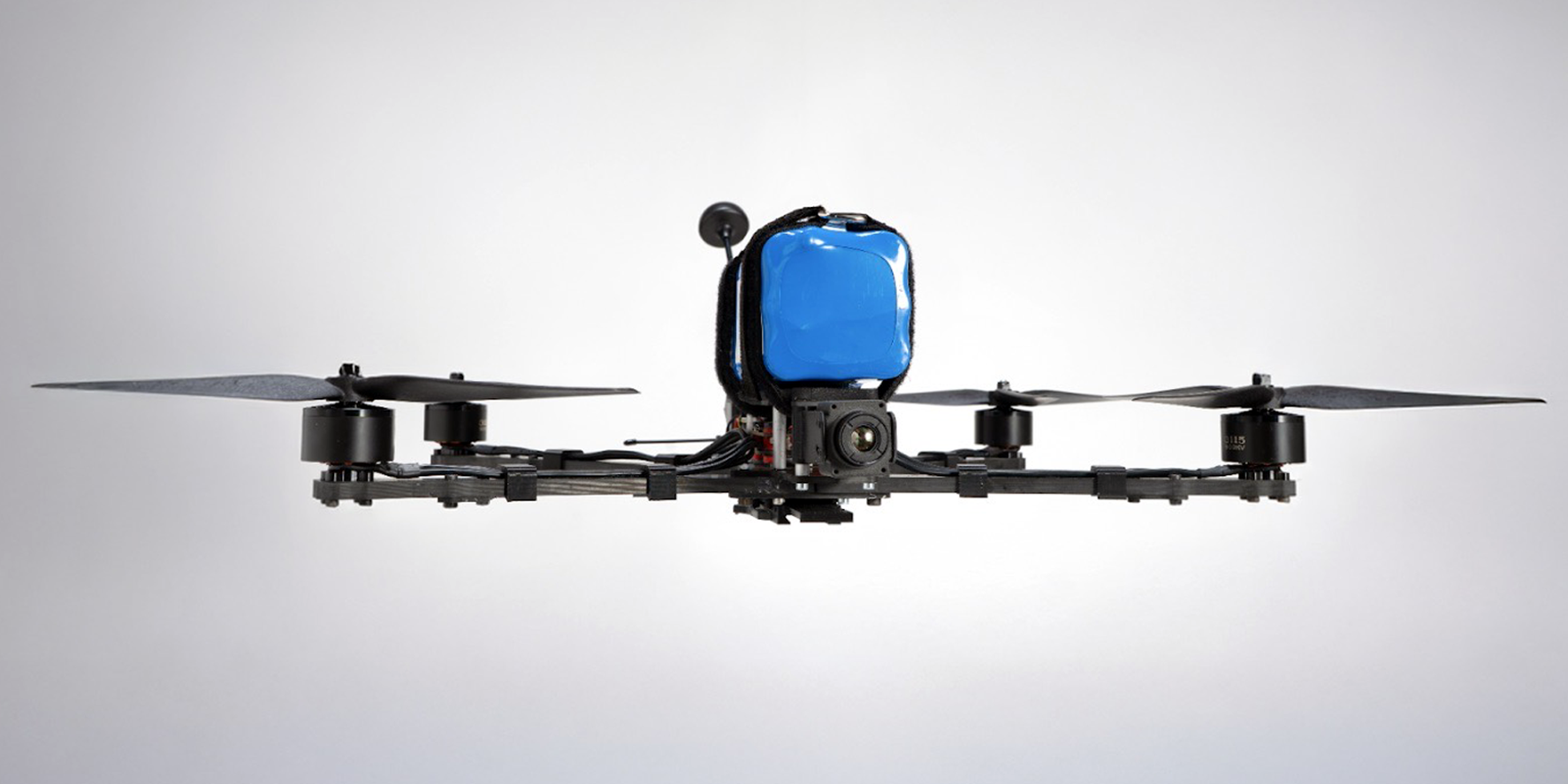
How AI Autonomous Drones See, Track, and Respond to Their Environment
Autonomous drones have gotten a lot smarter. They no longer just follow preset routes or dodge apparent obstacles. Thanks to advances in computer vision and AI, they can now recognise objects, track movement, and adjust their flight paths in real time — all without a pilot flipping most of the controls.
If you’re curious what’s under the hood of modern machine vision targeting and AI navigation systems, here’s a quick explainer.
How AI Turns Camera Footage into Useful Flight Data
Computer vision gives autonomous drones their eyes and the ability to make sense of what they see. Deep learning algorithms detect and classify objects, like vehicles or people. Traditional computer vision algorithms focus on visual feature recognition — edges, landmarks, and movement between frames — to help UAVs estimate motion and avoid collisions.
The optimal algorithm choice heavily depends on the key task. For example:
- Visual-inertial odometry (camera + IMU estimator + pre-trained model) enables reliable navigation in GPS-denied environments.
- Visual SLAM is a proven choice for indoor navigation and mapping.
- YOLO-family detectors are a common choice for quick object detection with solid accuracy.
You can also combine several algorithms to enable more advanced autonomous capabilities. One research group paired YOLOv4 object detection with DeepSORT tracking to monitor multiple vehicles in urban environments. They also used an advanced particle filtering algorithm to estimate the positions of moving vehicles.
Their system achieved 65-77% multi-object tracking accuracy across five test sequences, while the particle filtering algorithm delivered more accurate positioning of manoeuvring vehicles than the alternative methods tested.
From Detection to Tracking: Following Objects Across Frames
Detection identifies an object now. Tracking maintains its identity as its appearance and position change.
Once again, you have a host of options. Popular machine vision targeting algorithms include:
- ByteTrack: Associates detections across frames in two stages, including lower-confidence detections to track multiple objects even in crowded footage, with relatively high accuracy.
- BoT-SORT: Adds camera-motion compensation and appearance cues to tracking-by-detection for higher-accuracy results.
- SiamAPN: Tracks one selected object with high accuracy at 30 FPS on UAVs. Requires fewer compute resources.
In a 2014 study with autonomous fixed-wing UAVs, the team went with a lightweight, Laplacian-based computer vision algorithm to distinguish the vehicle from its surroundings, even under changing lighting conditions. To determine its position, they combined camera observations with aircraft attitude data from an inertial measurement unit (IMU), camera orientation from a pan-tilt unit, and GPS-based altitude measurements. They also used a
Kalman filter to estimate the vehicle’s position and velocity, while a modified guidance algorithm adjusted the UAV’s flight path to maintain tracking.
The modified guidance algorithm reduced tracking-distance error by approximately 75% under specified conditions in simulations and real-world flight tests. However, raw target-localization errors occasionally reached 60 meters, partly because of sensor timing, camera calibration, and the assumption of constant ground elevation.
But today, there are ways to overcome such accuracy issues.
How AI Combines Sensor Data for More Accurate Flight Control
As the drone zooms around, stationary objects move across its camera feed. So accurate scene interpretation requires a constant estimate of the aircraft’s position, velocity, and attitude.
That’s where sensor fusion picks up the slack. Onboard algorithms combine complementary measurements, e.g., from gyroscopes, accelerometers, magnetometers, barometers, airflow sensors, cameras, and LiDAR, to build a more accurate estimate
Our AI navigation kit, for example, combines Hybrid INS hardware with AI sensor-fusion algorithms for GNSS-denied navigation. This provides the navigation layer supporting flight control, with visual object recognition handled separately where the application requires it.
Once the system estimates what is happening, guidance or planning determines the desired movement. Flight controllers execute the necessary corrections in real time.
Processing location also matters. Running critical functions onboard reduces dependence on communications links, but introduces power and compute constraints. That’s why we designed our kit to deliver reliable onboard processing without adding excessive weight or power demands.
Our low-SWaP architecture packs these capabilities into a compact onboard unit:
- 800 g total weight, including IMU, edge computer, AI-powered flight control, and protective enclosure.
- Compact 150 × 134 × 73 mm footprint for integration across different UAV configurations.
- Standard +5V power supply, with a specified maximum current draw of 10A (50W) and peak current of 12A.
- Integrated sensor array, including accelerometer, gyroscope, compass, barometer, and multi-vector airflow sensor, with support for additional inputs.
- Built-in PX Cube flight controller, plus the option to output synthetic GPS coordinates to an existing autopilot.
Effectively, you get a self-contained navigation system designed to maintain autonomous flight capabilities and perform extra object detection and targeting tasks, even when satellite positioning is unavailable or unreliable
Explore our AI Navigation Kit and talk to our team about integrating it into your UAV platform.